Advancing Prevention Research in Cancer through Ontology Tools (The APRICOT Project)
Award Number: U01CA291884
NIH RePORTER Project Details: https://reporter.nih.gov/search/ZD5diu2sCU-4cOw1ZKYs4Q/project-details/11176848
Principal Investigator
Overview
1.
Research into cancer prevention through behavior change, like other areas of behavioral science, is hampered by imprecision and heterogeneity in the use of constructs across studies and data sets, limiting integration and knowledge accumulation
2.
We have developed a large, semantically rich, Behavior Change Intervention Ontology (BCIO) with associated tools and resources that together provide a starting point for developing an innovative solution to this problem
3.
We will engage with a diverse Community of Practice to set up an ongoing and sustainable program to:
a.
enhance and extend the BCIO, specifically focusing on the behavioral cancer risk factors of tobacco use and physical (in)activity, and including causal relations between intervention components and mechanisms of action (processes of change)
b.
integrate the BCIO with other ontologies capturing “real-world” data to better address issues relating to the Social and Environmental Determinants of Health (e.g., poverty, educational level, gender identity and sexual orientation, racial and ethnic group, and built environment), and
c.
develop tools and resources to promote effective and widespread adoption of the BCIO for writing study reports and protocols, and evidence synthesis for theory building and intervention development
Aims
1.
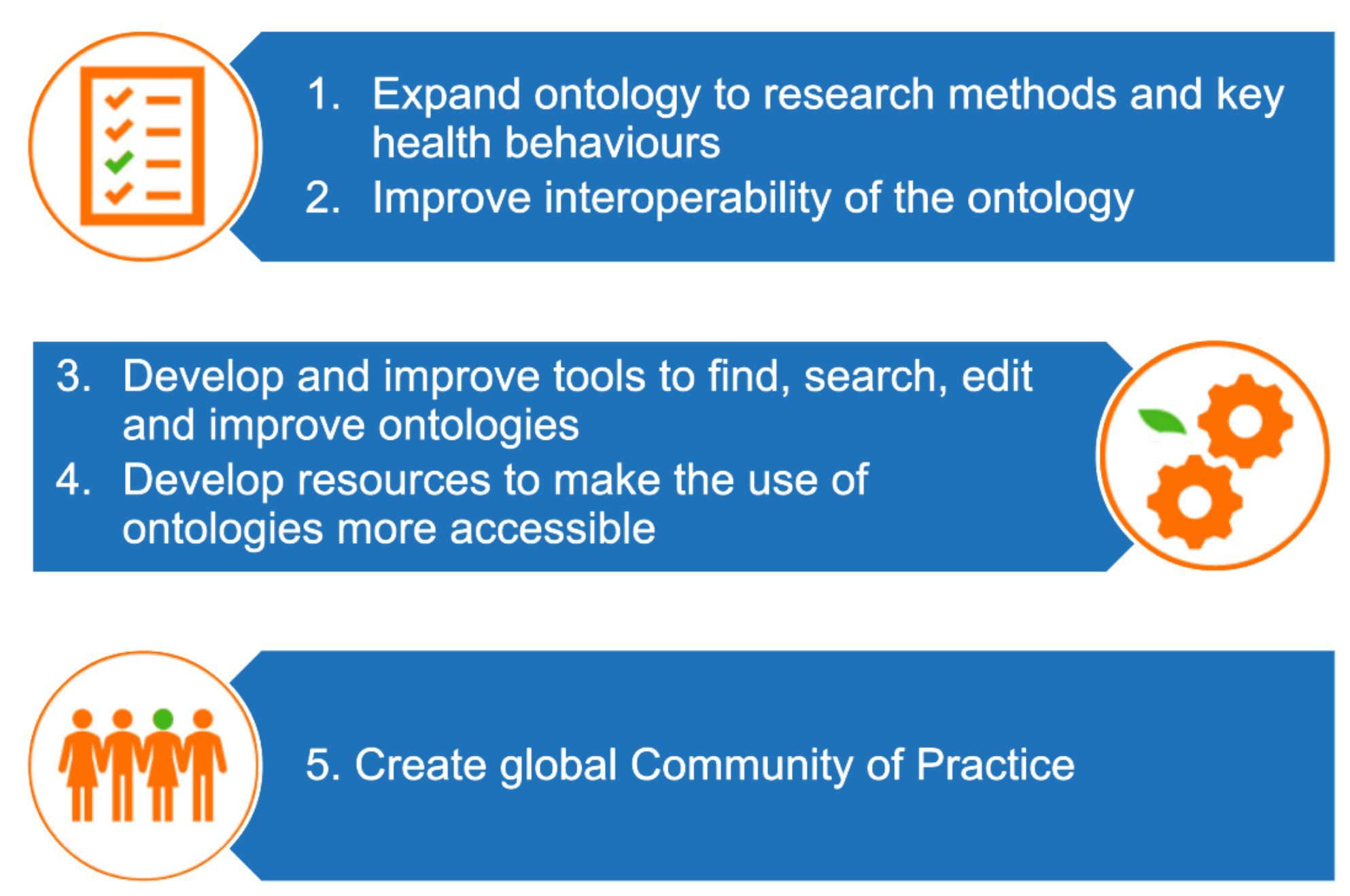
Extend the BCIO by including new classes, relations and mappings. We will apply our established iterative, user-informed ontology development process to add ontology classes with labels, definitions, relations and metadata, checking usability throughout. We will focus on key gaps in the current version of the BCIO
a.
details of behavioral outcomes that are not currently covered in the BCIO,
b.
causal relations between intervention components and mechanisms of action (processes of change) as a function of population and setting characteristics, particularly SEDoH,
c.
methodological features of intervention evaluation studies including study designs, features of outcome assessment, and measures and their relations to constructs, and
d.
cross-references to important vocabularies (e.g., NCI Thesaurus, SNOMED CT, the FHIR Gravity Project, and UMLS Knowledge Sources).
2.
Align BCIO further with ontologies designed to capture "real-world" SEDoH data. We will integrate BCIO with the Ontology of Medically Relevant Social Entities (OMRSE), ensuring that key classes relating to SEDoH (e.g., poverty, educational level, gender identity and sexual orientation, racial and ethnic group, and built environment) are re-used. We will aim to integrate BCIO (re-use classes) with other ontologies capturing "real-world" data but failing that will map classes to each other using cross-referencing.
3.
Upgrade and extend our online tools and resources for using the BCIO: We will upgrade and extend our Paper Authoring Tool (PAT) to create a Paper and Protocol Authoring and Annotation Tool (PPAAT) for:
a.
writing study protocols and reporting studies using the BCIO and other ontologies, lexicons, vocabularies and taxonomies, and
b.
annotating ontological entities in existing reports of behavioral intervention evaluations, providing seamless integration of papers and protocols with the BCIO and other ontologies, lexicons etc. We will also upgrade our Theory and Techniques Tool (TaTT) for identifying potential theory-based causal relations between behavior change techniques and their mechanisms of action.
4.
Upgrade and extend our online tools and resources for using the BCIO: We will upgrade and extend our Paper Authoring Tool (PAT) to create a Paper and Protocol Authoring and Annotation Tool (PPAAT) for:
5.
Create a global community of practice (CoP) - a collaborative network dedicated to fostering knowledge sharing, co-creation, and innovation in support of APRICOT tools and resources. The CoP aims to:
a.
Foster collaboration and knowledge sharing among diverse stakeholders involved in ontology development, implementation, and use;
b.
Support the co-creation of resources and tools that reflect the needs of future users and stakeholders, including researchers, practitioners, and policymakers;
c.
Enhance learning and capacity building through ongoing dialogue and shared practices;
d.
Promote inclusive governance and community stewardship aligned with EDII principles;
e.
Advance the goals of the BSSO Foundry, ensuring that behavioural science ontologies are findable, accessible, interoperable, reusable (FAIR), and embedded in the wider scientific and policy infrastructure.
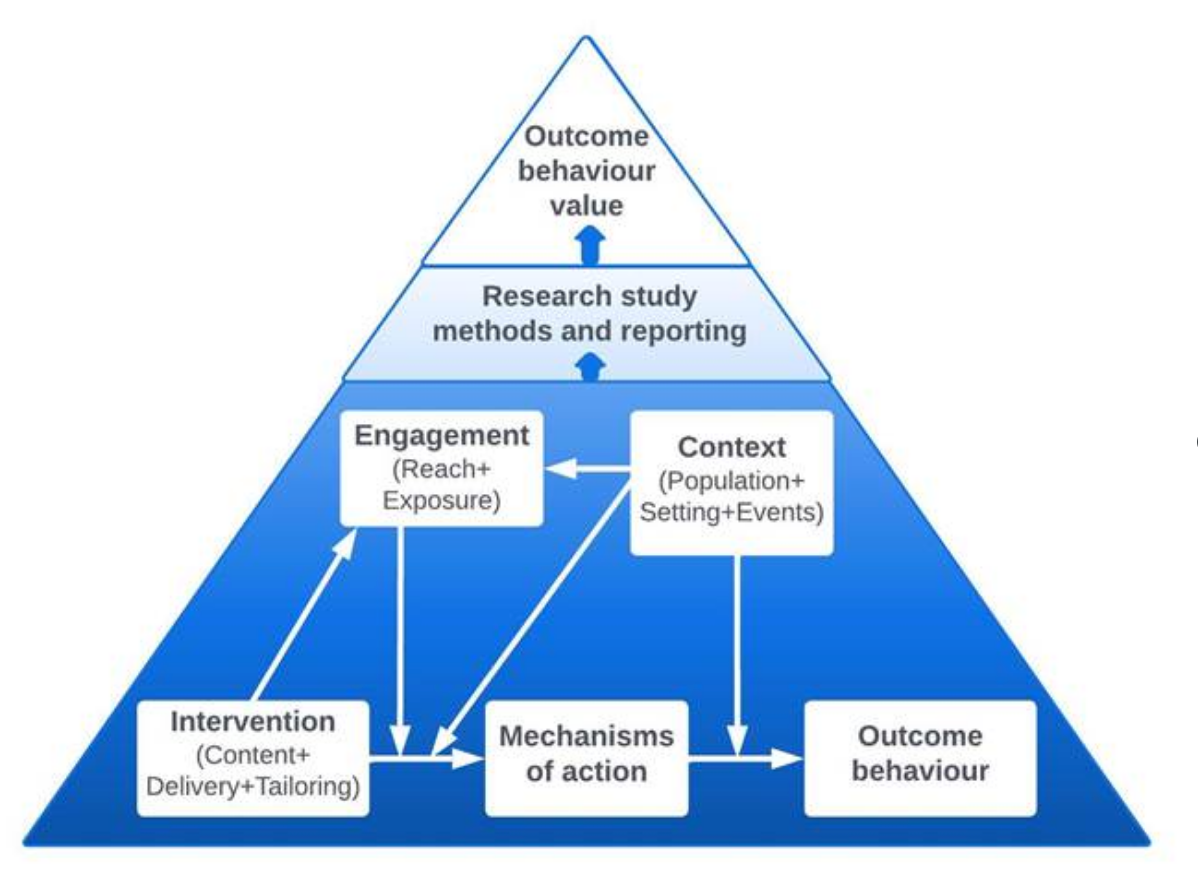
BCIO Upper Level Structure
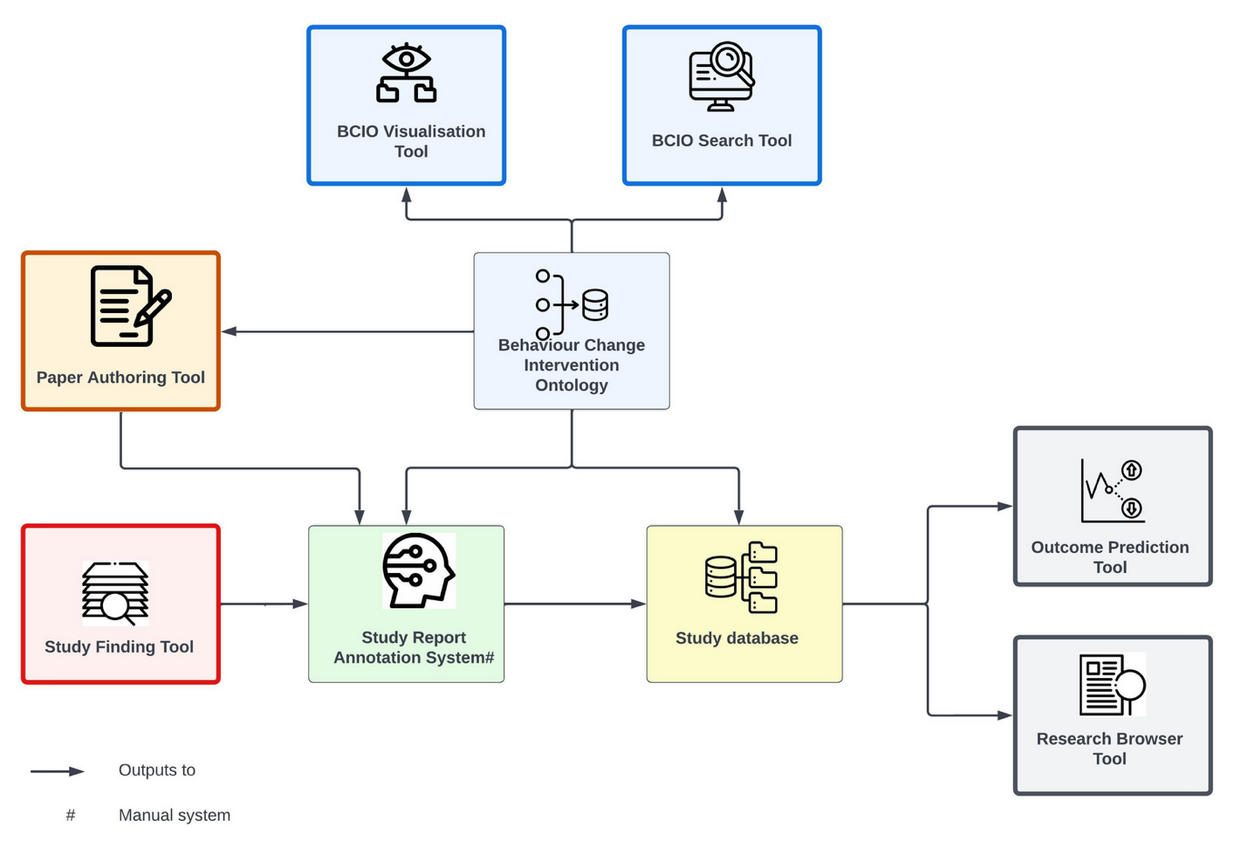
BCIO and its Tools
Resources
1.
Updates to OntoSpreadEd: https://github.com/ontology-tools/onto-spread-ed/
2.
Updates to Theory and Techniques Tool: https://theoryandtechniquetool.humanbehaviourchange.org/tool
3.
Updates to Theory Database: https://theory-database.hbcptools.org/
4.
Schema for Ontology-based Data Annotation: https://osf.io/j43wm/
Team

Susan Michie
Principal Investigator
Susan Michie, PhD, University College London, United Kingdom, s.michie@ucl.ac.uk
A world leader in behavioural science, her research focuses on understanding behaviour change theoretically, developing methods for designing effective interventions and translating evidence into practice and policy.
Professor Michie developed the Behaviour Change Wheel framework and leads the Human Behaviour Change Project and has several policy-related responsibilities such as in her roles as co-Director of Behavioural Research UK, and Director of UCL's Centre for Behaviour Change.

William Hogan
Co-Investigator
William Hogan, PhD, Medical College of Wisconsin, United States of America, hoganwr@mcw.edu
Dr. Hogan's core area of interest is biomedical ontology, or how to represent the types of things that are objects of study in healthcare and biomedical science in order to ensure that data are reusable and that information systems are interoperable.
He is the creator and lead curator of three major ontologies in the Open Biological and Biomedical Ontology (OBO) Foundry: the Drug Ontology, the Ontology for Modeling and Representing Social Entities, and the Apollo-SV ontology.
All three ontologies rank in the top 20% of OBO ontologies in terms of re-use by other OBO ontologies. He serves on the OBO Foundry Operations Committee and its Editorial Working Group.

Marta Marques
Co-Investigator
Marta Moreira Marques, PhD, NOVA National School of Public Health, Portugal, mmarques@ensp.unl.pt
Marta M. Marques is an Assistant Professor at the NSPH NOVA in the area of Health Promotion and Behavioral Sciences. She is also a member of the Comprehensive Health Research Center (CHRC) and a collaborator of the Centre for Behaviour Change (University College London, UK).
Her main area of research focuses on the development of methods and theories to advance behavioral science and their application in the development and evaluation of complex interventions (including digital ones) aimed at changing health behaviors in a public health context.
Janna Hastings
Co-Investigator
Janna Hastings, PhD, University of Zurich, Switzerland, janna.hastings@uzh.ch
Prof Hastings is a computer scientist and has been developing and using ontologies and knowledge-based technologies in scientific research for more than a decade.
Since August 2022 she has been Assistant Professor of Medical Knowledge and Decision Support in the Faculty of Medicine, Institute for Implementation Science in Health Care at the University of Zurich, and Vice-Director of the School of Medicine at the University of St. Gallen, Switzerland.

Robert West
Expert Consultant
Robert West, PhD, University College London, United Kingdom
Prof West co-founded the Behaviour Change Wheel, the Capability-Opportunity-Motivation-Behaviour (COM-B) model of behaviour, and the PRIME Theory of motivation. He has more than 900 academic publications including numerous books on behavioural science.
He is former Editor-in-Chief of the academic journal, Addiction, and has acted as an advisor to the UK Government and currently advises the Welsh Government.

Marie Johnston
Expert Consultant
Marie Johnston, PhD, University of Aberdeen, United Kingdom, m.johnston@abdn.ac.uk
Prof Johnston is a Fellow of the Royal Society of Edinburgh, the Academy of Medical Sciences, the Academy of Learned Societies for the Social Sciences, the Royal College of Physicians of Edinburgh and Honorary Fellow of the British Psychological Society, European Health Psychology Society and the Health Psychology and Public Health Network.
She conducts research on behaviour change in health and healthcare contexts and on disability (theory, measurement and intervention)

Alex Rothman
Expert Consultant
Alex Rothman, PhD, University of Minnesota Twin Cities, United States of America, rothm001@umn.edu
Alexander (Alex) Rothman is a Professor in the Department of Psychology. He received his doctoral training in social psychology from Yale University and has been on the faculty at the University of Minnesota since 1995.
Dr. Rothman's primary program of research concerns the development and application of basic psychological principles to advance illness prevention and health promotion and is comprised of a synthesis of basic research on how people process and respond to health information with the development and evaluation of theory-based interventions to promote healthy behavior.
Working across a broad array of health domains, he has contributed to our understanding of a range of issues including why and when different health communication strategies are most effective, the decision processes that underlie the initiation and maintenance of behavior change, and the development of strategies for optimizing the integration of theory and practice.
Matthew West
Consultant

Maya Braun
Researcher
Maya Braun, PhD, University of Zurich, Switzerland, maya.braun@uzh.ch
Dr. Maya Braun's research focuses on understanding and promoting health behaviours by improving our understanding of our measures and theories, improving how we approach measurement and data analysis, and adapting interventions to the individual and their context.

Paulina Schenk
Researcher
Paulina Schenk, PhD, University College London, United Kingdom, paulina.schenk.13@ucl.ac.uk
Dr Schenk has been working as a Research Fellow at CBC since 2022. Her research experience has been around developing and applying theories and frameworks to synthesise knowledge about behaviour change and mental health interventions.
Paulina completed her PhD in Health Psychology at UCL in 2022, developing an ontology of mechanisms of action in behaviour change interventions. Since then, she has worked on developing ontologies as part of the Human Behaviour Change Project and supporting projects around behaviour change in healthcare as part of the NIHR Policy Research Unit.
Her current work focuses primarily on developing an ontology of mental health as part of the Galenos Project.

Carolina Silva
Researcher
Carolina Silva, PhD, NOVA National School of Public Health, Portugal, carolina.silva@ensp.unl.pt
Carolina Silva conducts research in health psychology and behavioural sciences, focusing on multiple behaviour change and healthcare professionals' clinical behaviours.
Carolina completed her PhD in Health Psychology at Trinity College Dublin in 2024, focusing on advancing the theoretical understanding of multiple behaviour change approaches in chronic disease and multimorbidity management.
She is now part of the APRICOT project, where she contributes to expanding and improving ontologies for behavioural science, as well as developing a community of practice to support their use and application.
Milly Massoura
Administrator
Milly Massoura, PhD, University College London, United Kingdom, m.massoura@ucl.ac.uk

Micaela Santilli
Researcher
Micaela Santilli, MSc, Centre for Behaviour Change, University College London
Publications
Apricot Editorial
Michie S, Hastings J, Hogan W et al. Advancing Behavioural and Social Sciences through Ontologies: Protocol for the APRICOT Project. Wellcome Open Res 2025, 10:691. https://doi.org/10.12688/wellcomeopenres.24994.1
Michie S, West R, Hastings J et al. The Human Behaviour-Change Project Phase 2: Advancing behavioural and social sciences through ontology tools. Wellcome Open Res 2024, 9:730. https://doi.org/10.12688/wellcomeopenres.23520.1
Human Behaviour Change Project & APRICOT Ontology Work
Wright AJ, Finnerty Mutlu AN, Norris E et al. Development of an Intervention Population Ontology for specifying the characteristics of intervention participants. Wellcome Open Res 2025, 10:122 https://doi.org/10.12688/wellcomeopenres.22788.1
Finnerty Mutlu AN, Schenk PM, Eymery EJ et al. Development of an Ontology of Engagement with Behaviour Change Interventions. Wellcome Open Res 2025, 10:409 https://doi.org/10.12688/wellcomeopenres.24239.1
Ontologies in General
Webb TL, Baird HM, Maikore FS et al. A Method for Evaluating the Interoperability of Ontology Classes in the Behavioural and Social Sciences. Wellcome Open Res 2025, 10:525 https://doi.org/10.12688/wellcomeopenres.24206.1
APRICOT & Related Tools
Castro O, Norris E, Wright AJ et al. From smoking cessation to physical activity: Can ontology-based methods for automated evidence synthesis generalise across behaviour change domains? Wellcome Open Res 2025, 9:402 https://doi.org/10.12688/wellcomeopenres.21664.2
Hastings J, Glauer M, West R et al. Predicting outcomes of smoking cessation interventions in novel scenarios using ontology-informed, interpretable machine learning. Wellcome Open Res 2025, 8:503 https://doi.org/10.12688/wellcomeopenres.20012.2
Zhang L, Schenk PM, Santilli M et al. Linking behaviour change techniques to mechanisms of action: Using the Theory and Techniques Tool alongside the Behaviour Change Intervention Ontology. Wellcome Open Res 2025, 10:192. https://doi.org/10.12688/wellcomeopenres.23879.1
Gehrke B, Braun M, Schenk P et al. OntoSpreadEd: Developing Ontologies with a Dedicated Online Template Spreadsheet Editor. Wellcome Open Res 2025, 10:360 https://doi.org/10.12688/wellcomeopenres.24408.1
West R, Brown J, Shahab L et al. Annotating datasets in behavioural and social sciences to promote interoperability: development of the Schema for Ontology-based Dataset Annotation (SODA) version 1.0. Wellcome Open Res 2025, 10:455 https://doi.org/10.12688/wellcomeopenres.24234.1
Rodger A, Helman S, West R et al. Use of an ontology-based framework for annotating reports of randomised trials of interventions aimed at reducing excessive driving speed: a feasibility study. Wellcome Open Res 2025, 10:471 https://doi.org/10.12688/wellcomeopenres.24283.1